
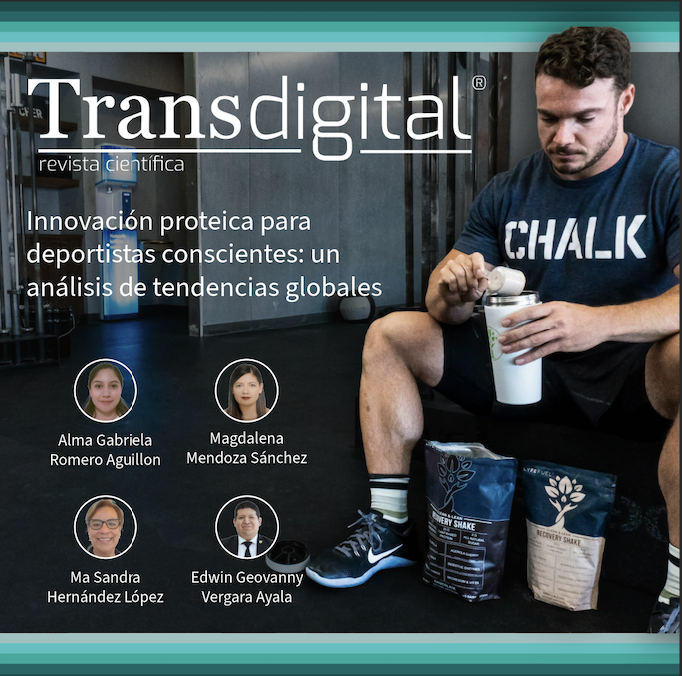
Innovación proteica para deportistas conscientes
un análisis de tendencias globales
DOI:
https://doi.org/10.56162/transdigital446Palabras clave:
patrones de consumo, tendencias nutricionales, nutrición deportiva, suero de leche, aminoácidos esencialesResumen
A nivel global, la creciente preocupación por la salud y el bienestar impulsó cambios en los hábitos de consumo alimentario, favoreciendo el desarrollo de productos funcionales y sostenibles. Este estudio analizó las tendencias de consumo en nutrición deportiva enfocadas en proteínas, particularmente del suero de leche, mediante una revisión sistemática de literatura y análisis bibliométrico con VOSViewer. Se identificaron patrones de cambio en las preferencias de consumo y el aprovechamiento de subproductos agroindustriales como fuentes proteicas alternativas. Los resultados mostraron la creciente demanda de alimentos funcionales de origen sostenible y el potencial de los subproductos lácteos como ingredientes estratégicos en la nutrición deportiva. Se discuten las implicaciones para la industria alimentaria y las oportunidades para desarrollar nuevos productos basados en economía circular. Este trabajo proporcionó una perspectiva integral para orientar a los investigadores y a la industria en el diseño de soluciones nutricionales innovadoras.
Citas
Alghannam, A. F., Ghaith, M. M., & Alhussain, M. H. (2021). Regulation of energy substrate metabolism in endurance exercise. International Journal of Environmental Research and Public Health, 18(9), 4963.
Arenas-Jal, M., Suñé-Negre, J. M., Pérez-Lozano, P., & García-Montoya, E. (2020). Trends in the food and sports nutrition industry: A review. Critical Reviews in Food Science and Nutrition, 60(14), 2405–2421.
Berman, A. Y., Motechin, R. A., Wiesenfeld, M. Y., & Holz, M. K. (2017). The therapeutic potential of resveratrol: A review of clinical trials. NPJ Precision Oncology, 1, 35.
Bonilla, D. A., Boullosa, D., & Del Coso, J. (2023). Advances in Nutrition, Dietary Supplements and Ergogenic Aids for Athletic Performance: Trends and Future Prospects. Nutrients, 15(10), 2246.
Chen, L., Zhu, Y., Hu, Z., Wu, S., & Jin, C. (2021). Beetroot as a functional food with huge health benefits: Antioxidant, antitumor, physical function, and chronic metabolomics activity. Food science & nutrition, 9(11), 6406-6420.
FAO. (2018). El estado de la seguridad alimentaria y la nutrición en el mundo 2018. Food and Agriculture Organization of the United Nations. https://openknowledge.fao.org/server/api/core/bitstreams/6e25cc6e-d527-4651-b781-11a6349ee80f/content
FAO. (2023). Educación Alimentaria y Nutricional. Página web oficial de la Food and Agriculture Organization of the United Nations. https://www.fao.org/nutrition/educacion-nutricional/es/
Fuentes Berrio, L., Acevedo Correa, D., & Gelvez Ordoñez, V. M. (2015). Alimentos funcionales: Impacto y retos para el desarrollo y bienestar de la sociedad colombiana. Biotecnología en el Sector Agropecuario y Agroindustrial, 13(2), 140–149. https://doi.org/10.18684/BSAA(13)140-149
Gustavsson, J., Cederberg, C., Sonesson, U., Van Otterdijk, R., & Meybeck, A. (2011). Global food losses and food waste: Extent, causes and prevention. Food and Agriculture Organization of the United Nations. https://www.fao.org/3/i2697e/i2697e.pdf
Henríquez, C., Speisky, H., Chiffelle, I., Valenzuela, T., Araya, M., Simpson, R., & Almonacid, S. (2010). Development of an ingredient containing apple peel as a source of pectin and dietary fiber. Journal of Food Science, 75(5), C444–C450.
INEGI. (2024). Módulo de práctica deportiva y ejercicio físico (MOPRADEF) 2024. Instituto Nacional de Estadística y Geografía. https://www.inegi.org.mx/contenidos/saladeprensa/boletines/2025/mopradef/mopradef2024.pdf
Innova Market Insights. (2023). Tendencias de consumo en América Latina. Página web oficial de Innova Market Insights. https://www.innovamarketinsights.com/es/tendencias/tendencias-de-consumo-en-america-latina/
Kumar, K., Yadav, A. N., Vyas, P., & Singh Dhaliwal, H. (2017). Food waste: a potential bioresource for extraction of nutraceuticals and bioactive compounds. Bioresources and Bioprocessing, 4, 18.
Nissar, J., Sidiqi, U. S., Dar, A. H., & Akbar, U. (2025). Nutritional composition and bioactive potential of watermelon seeds: a pathway to sustainable food and health innovation. Sustainable Food Technology, 3(2), 375-395.
Peñalver, R., Martínez?Zamora, L., Lorenzo, J. M., Ros, G., & Nieto, G. (2022). Nutritional and Antioxidant Properties of Moringa oleifera Leaves in Functional Foods. Foods, 11(8), 1107.
Rawat, N., Das, S., Waheed Wani, A., & Javeed, K. (2024). Antioxidant potential and bioactive compounds in banana peel: A review. Peer Reviewed Journal, 7(7).
Rubóczki, T., & Takácsné Hájos, M. (2018). Leaf and root evaluation of bioactive compounds of different beetroot varieties. Acta Alimentaria, 47(2), 123–133. https://doi.org/10.34101/actaagrar/74/1678
Shi, P., Yuen Kai, R. N., Vijayan, P., Lin Lim, S., & Bhaskaran, K. (2023). Valorization of spent barley grains: isolation of protein and fibers for starch-free noodles and its effect on glycemic response in healthy individuals. Frontiers in Sustainable Food Systems, 7, 1146614.
S?awi?ska, N., & Olas, B. (2022). Selected Seeds as Sources of Bioactive Compounds with Diverse Biological Activities. Nutrients, 15(1), 187.
Soria-Romero, Z., & Montoya-Arce, B. J. (2017). Envejecimiento y factores asociados a la calidad de vida de los adultos mayores en el Estado de México. Papeles de Población, 23(93), 59–93. https://rppoblacion.uaemex.mx/article/view/9089
Statista. (2024). Tasa de crecimiento anual compuesto de la industria de alimentos para la salud y el bienestar entre 2022 y 2030, por sector. Página web oficial de Statista. https://es.statista.com/estadisticas/1424768/tcac-de-la-industria-de-alimentos-para-la-salud-y-el-bienestar-en-el-mundo/
Statista. (2025). Proyección del mercado global de nutrición deportiva y suplementos (2023–2028). Página web oficial de Statista. https://www.statista.com/statistics/450168/global-sports-nutrition-market/
Strain, T., Flaxman, S., Guthold, R., Semenova, E., Cowan, M., Riley, L. M., Bull, F. C., & Stevens, G. A. (2024). National, regional, and global trends in insufficient physical activity among adults from 2000 to 2022: A pooled analysis of 507 population-based surveys with 5.7 million participants. The Lancet Global Health, 12(5), e773–e786. https://doi.org/10.1016/S2214-109X(24)00150-5
Sung-Wook, H., Kyu-Man, C., & Seong-Jun, C. (2015). Nutritional quality of rice bran protein in comparison to animal and vegetable protein. Food Chemistry, 172, 766–769.
Van Loon, L. J. C. (2007). Application of protein or protein hydrolysates to improve post-exercise recovery. International Journal of Sport Nutrition and Exercise Metabolism, 17(Suppl), S104–S115.
Autor de correspondencia
El autor de correspodencia se identifica con el siguiente símbolo: *Publicado
Cómo citar
Número
Sección
Categorías
Licencia
Derechos de autor 2025 Alma Gabriela Romero Aguillon, Magdalena Mendoza Sánchez, Ma Sandra Hernández López, Edwin Geovanny Vergara Ayala

Esta obra está bajo una licencia internacional Creative Commons Atribución 4.0.
Todos los artículos en Transdigital están licenciados bajo Creative Commons Attribution 4.0 International License Los autores poseen los derechos de autor y conservan los derechos de publicación sin restricciones.